THANK YOU! Your submission has been received!
Oops! Something went long while falling the form.

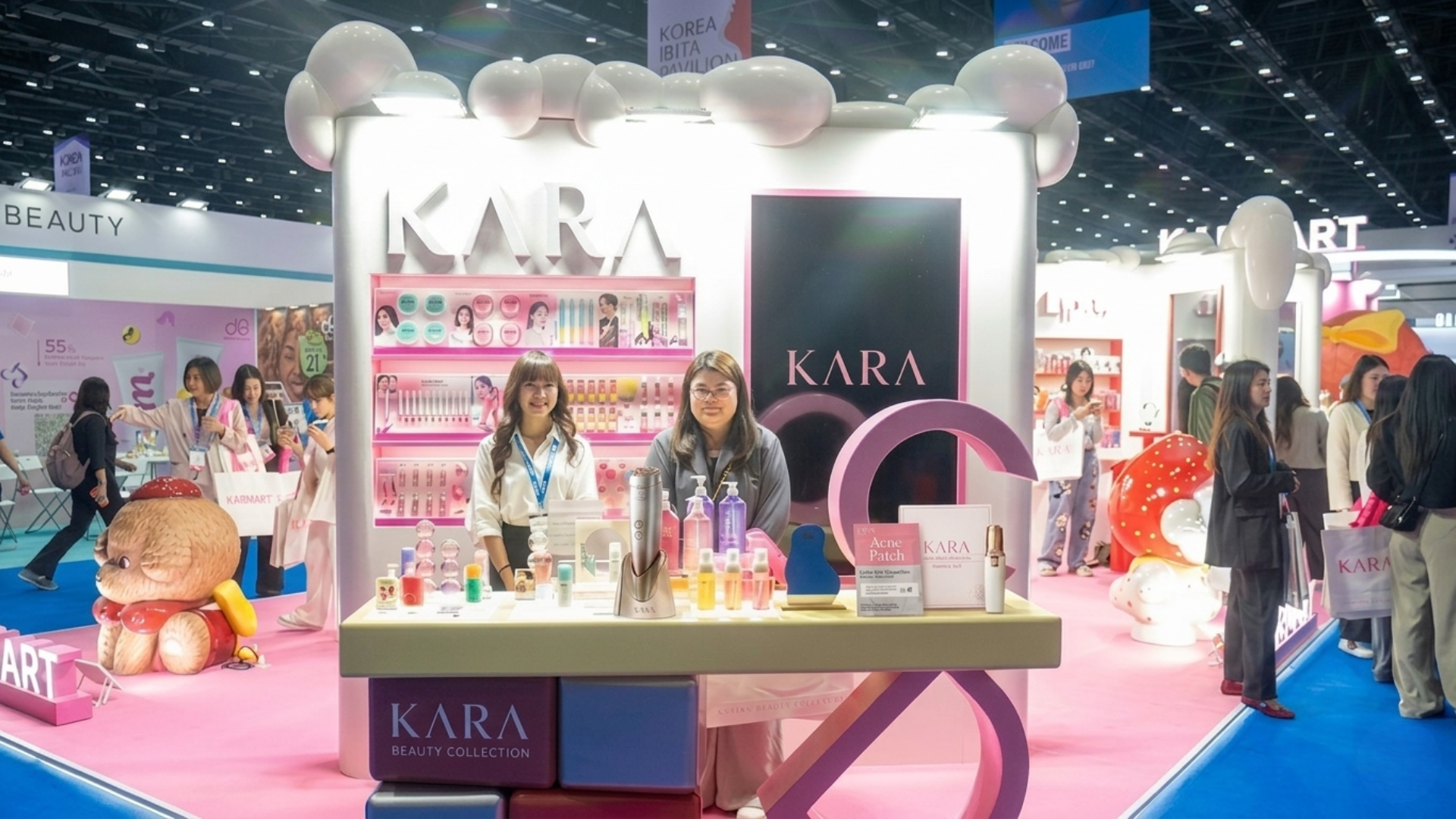
Kara Clinical’s participation at KCON had a character unlike that of any industrial fair. Here the brand did not present itself to buyers or chemists: it presented itself to the most informed and most demanding audience of contemporary cosmetic consumption — the generation that learned K-Beauty before learning skincare as a category, that knows Korean ingredients by their hangul name, that distinguishes brands by their philosophy and not only by their packaging. That audience does not allow improvisation.
The brand arrived at KCON with the editorial decision not to translate its clinical identity into the language of generic fan service. Instead, it proposed a conversation where Korean formulatory rigour was presented as the natural continuation of the cultural sophistication the audience itself was already celebrating in other Hallyu products — in the music, in the Korean serial narrative, in the fashion. That coherence functioned as a differentiator.
Unlike B2B fairs, where the booth is built around the technical table, KCON demands experience. Kara Clinical’s activation prioritised the immediate legibility of clinical Korean visual language — precise typography, neutral palette, materials inviting unhurried contact — combined with interaction formats that respected the generational codes: demonstrations, product self-discovery spaces, photography adapted to the platforms where the audience documents its own experience. That decision did not dilute the clinical identity: it translated it.
KCON’s audience is one of the most documented and participatory of the global cultural calendar. Its corridors brought together international K-pop fans with detailed knowledge of the skincare rituals of their favourite artists, Gen-Z consumers with deep literacy in Korean ingredients, multilingual audiences capable of moving between Korean, English, Japanese, Spanish and Arabic within a single conversation, and digital communities that would document the festival experience on platforms like TikTok, Instagram, X, Xiaohongshu, Korean Twitter and Weverse for days after the event.
The festival kept its character as amplified cultural platform: a place where every in-person interaction has a digital echo effect that multiplies the original reach by orders of magnitude. Kara Clinical found in that atmosphere an audience that valued conversational authenticity above visual production investment. The questions the brand received were not about upcoming launches but about formulation, about brand philosophy, about the difference between clinical Korean cosmetics and Western premium cosmetics, about the logic behind every formulatory decision.
What distinguished conversation at KCON was a specific layer that other participations in the archive did not require. The Gen-Z Hallyu audience is not a passive audience that listens to brands: it is an audience that has spent years evaluating brands in community, and that arrives at KCON with questions already formulated. Kara Clinical moved within that register with the naturalness of a house understanding that the era of the receptor consumer ended long ago. Today, the consumer is co-author of the brand narrative.
READING THE CULTURAL FLOOR
Kara Clinical took part in that conversation from its own identity. The brand did not need to adopt the pop code to legitimise itself: it found in each of these trends a natural echo of its clinical proposition, read now from a generational gaze.
KCON functioned as an observatory of the directions Korean cosmetic activation would take in the months that followed. Innovations across the festival’s beauty sections included participatory demo formats where the audience co-formulates the experience, ingredient-learning spaces with accessible but technically correct language, digital integrations connecting the physical experience with social-media extensions, and curatorial narratives where brands presented their products as part of a wider philosophical proposition.
For Kara Clinical, walking that landscape was not only an exercise in experiential marketing. It was a direct cultural reading: identifying which conversation formats with the Gen-Z audience sustain clinical rigour and which dilute it. That reading would inform editorial decisions the brand would take in subsequent months regarding its cultural-presence strategy.
KCON organises cultural conversation with a very particular cadence. The festival operates across several days, but the most relevant conversations are built in the margins: encounters with independent beauty content creators, conversations with representatives of international digital communities, exchanges with cultural journalists specialised in Hallyu, and dialogues with other K-Beauty brands sharing the challenge of building cultural narratives without sacrificing technical depth. That network, far from ornamental, formed a substantial part of the event’s value.
Kara Clinical participated in that circuit with the right cadence. Conversations unfolded in a new register for the brand: neither the technical register of B2B fairs, nor the commercial register of retail fairs, but the cultural register. That breadth of register — the capacity to inhabit different industrial languages without losing coherence — is one of the most valuable assets a clinical brand can build into its archive.
The brand held significant conversations with international beauty content creators, with representatives of digital communities specialised in Korean cosmetics, with cultural journalists documenting the Hallyu phenomenon from non-commercial perspectives, and with other K-Beauty brands interested in exploring shared formats of cultural presence. Those conversations did not necessarily translate into headlines, but they did translate into archive-grade relationships the brand preserved for later stages.
KCON, at the moment of Kara Clinical’s participation, captured K-Beauty in a specific cultural transition. The Korean industry had outgrown its phase of unidirectional projection — exporting Korean products to the world — and was entering a phase of bidirectional dialogue, where international audiences no longer consumed K-Beauty passively but co-produced its cultural meaning. Brands like Kara Clinical represented that new generation: houses that did not arrive at KCON to present Korea to the world, but to participate in a conversation the world was already having about Korea.
The evolution was triple. Culturally, K-Beauty stopped being an export and became a shared vocabulary. Generationally, the sector understood that the Gen-Z Hallyu audience was not a demographic segment but a cultural community with its own codes, knowledge hierarchies and authority. Narratively, the most solid brands understood that contemporary cosmetic storytelling could no longer be built from the unilaterality of the press release: it had to accept the format of open dialogue.
Kara Clinical read that evolution from inside the festival. That reading, different from the previous ones in the archive, complemented the formulatory gaze of In-Cosmetics, the domestic gaze of KINTEX and the export gaze of Cosmoprof Asia and Beautyworld, offering the brand a more complete view of the contemporary landscape.
KCON offered a truth industrial fairs cannot capture: K-Beauty is not validated only in the laboratory, nor only in retail, nor only in the specialised press. It is also validated — increasingly — in the cultural communities where its products live after consumption. The generation that documents its routine on TikTok, that shares hauls on Xiaohongshu, that builds ingredient guides on Reddit, that creates product fancams on X, is the generation that decides which Korean brands have cultural future and which remain in the short commercial cycle.
Kara Clinical’s participation at KCON also revealed a strategic truth: the narrative coherence of a clinical brand is not measured only by its technical depth but also by its capacity to inhabit cultural contexts without dissolving. Brands that only speak the language of the laboratory end up invisible to generational audiences; brands that only speak the language of fandom end up irrelevant to serious buyers. Editorial strength lies in sustaining both without sacrificing either.
Kara Clinical provides effective and safe solutions for various skin problems through carefully selected products and devices developed by experts.

.svg)
.svg)